Death of El Hacen Diarra: was a third police officer involved in his prone restraint?
Published on
El Hacen Diarra, who died in police custody at the 20th arrondissement police station in Paris, was pinned to the ground by several police officers during his arrest. Based on the analysis of an amateur video and a 3D model of the scene, Index’s investigation examines the probable presence of a third officer on the arrested man’s upper body.
- Incident date
- Location
- Paris (France)
- Victim(s)
- El Hacen Diarra (35 y.o.)
- Consequence(s)
- Death
- Force(s) involved
- National Police
- Methods employed
- Prone restraint
- Theme(s)
- Partner(s)
On the night of 14 to 15 January 2026, El Hacen Diarra, a 35-year-old Mauritanian national, died in police custody at the 20th arrondissement police station after suffering a cardiac arrest.
According to the Paris prosecutor’s office, El Hacen Diarra had been arrested at around 10:45 pm near his home, at the corner of rue Fernand Léger and rue des Pruniers, then taken to the 20th arrondissement police station. The prosecutor’s office stated that El Hacen Diarra had “been taken ill” “on a bench at the police station”. “A cardiorespiratory arrest was observed, and a police officer began cardiac massage, which was continued by firefighters when they arrived at 11:45 pm. The person’s death was pronounced at 12:20 am,” the prosecutor’s office told AFP on 17 January.
Also according to the prosecutor’s office, the body cameras of the officers who carried out the arrest recorded nothing, as their batteries were flat. The day after El Hacen Diarra’s death, however, a video of his arrest, filmed by an anonymous witness from the window of a neighbouring building, was made public and quickly circulated on social media. Index has analysed this video: its initial observations are published below.
The scene of the arrest


The arrest takes place opposite the Mûriers migrant workers’ hostel, where El Hacen Diarra lived. The video is filmed from above, looking down towards rue des Pruniers: the frame is partially obstructed by a wire-mesh fence running along the street; only the lower part of El Hacen Diarra’s body is clearly visible, the upper part being hidden by the fence.
When the video begins, El Hacen Diarra is visibly being restrained by two police officers holding him face down on the ground. One of them is standing on his left ankle. He is holding a Taser (stun gun), apparently still switched on, which he puts away in his tactical vest. According to the prosecutor’s office, the officers who arrested El Hacen Diarra used a Taser “notably on the ankle” to bring him to the ground.


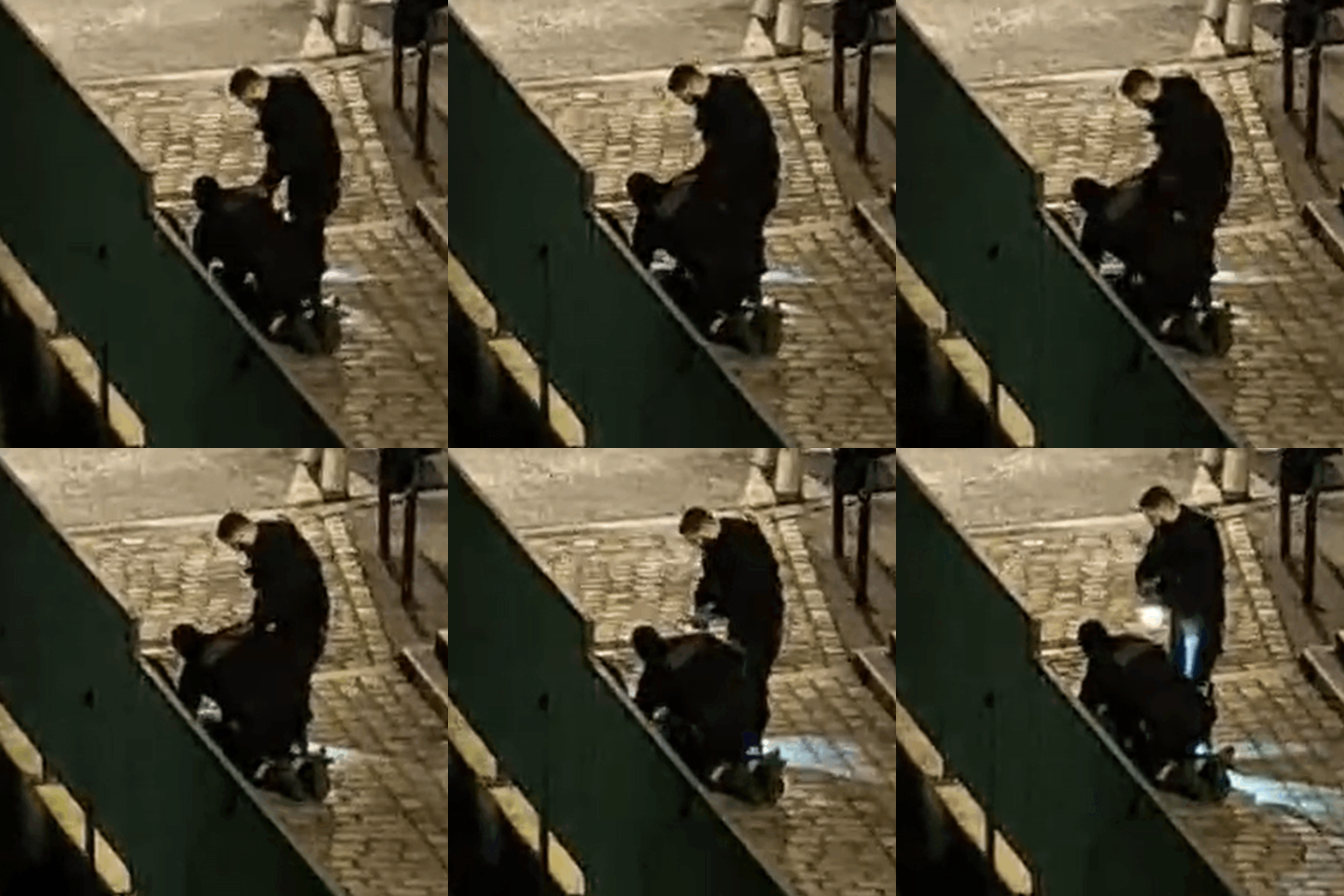
The second officer is lying across the back of El Hacen Diarra’s thighs. From the first moments of the video, he can be seen punching El Hacen Diarra twice in what appears to be his right flank, immediately followed by a verbal order: most likely, “Get on your stomach!” (Mets-toi sur le ventre !). At this point, it is therefore likely that El Hacen Diarra is not yet lying completely flat on his stomach (in the prone position), but that his upper body is still partially twisted.
Probable presence of a third police officer
Examination of the video reveals the movement of a dark shape along the area obstructed by the fence, on two distinct occasions. According to Index’s analysis, this shape appears to correspond to the body of a third police officer involved in the arrest. This conclusion is based on the following:


First, a 3D model of the two officers visible on El Hacen Diarra’s body reveals a tactical inconsistency if they were the only officers holding him down: his upper body would be left unrestrained. Yet the upper body – in particular the line of the shoulders – is the priority area to control when pinning someone to the ground.
Second, police crews are usually made up of three officers. In the footage analysed, only two officers are clearly seen controlling the lower body. It is therefore logical that the third member of the crew would be positioned at the upper body, even if he does not appear distinctly in the video frame.
Third, the movements of the dark shape observed in the obstructed area are consistent with the position and movements of a third officer controlling the upper body, in line with the ground restraint protocols taught in police training.
Nevertheless, the available footage does not make it possible to determine the exact position of this possible third officer, or to assess how much pressure he may have exerted. In particular, it remains impossible to determine which part of his body was pressing down (arm, knee, torso, chest), on which anatomical area (back, shoulders, neck, thorax), and for how long.
Forensic findings
The autopsy findings, released by the Paris prosecutor’s office on 19 January 2026, include several notable elements. In particular, a “fracture of the horn of the thyroid cartilage”, a part of the larynx. This injury is consistent with cervical trauma, particularly during strangulation or compression of the airways.
One detail supports this observation: at the 31st second of the video, a voice, most likely El Hacen Diarra’s, can be heard saying: “You’re strangling me!” (Vous m’étranglez !).
The prosecutor’s office also reports a “deep, bleeding right fronto-temporal wound, measuring 1.5 cm × 0.2 cm”. A video recorded the day after the events shows traces of blood on the paving stones at the site of the arrest. Using a photogrammetric survey, this bloodstain was placed to within a centimetre in the 3D model of the site. Its location corresponds exactly to that of El Hacen Diarra’s head as it appears in the footage of his arrest.
Conclusion
The analysis establishes that a third police officer probably took part in the prone restraint of El Hacen Diarra.
In the video, El Hacen Diarra is held in the prone position for at least 1 minute and 22 seconds.
Prone restraint: a dangerous technique
Prone restraint is an immobilisation technique that consists of holding a person face down under significant physical force. It carries a high risk of positional asphyxia. Although banned in several American cities (New York, Los Angeles) as well as in Switzerland and Belgium, it remains authorised in France.
This technique has been implicated in several documented deaths in France. Notably that of Cédric Chouviat, a 42-year-old delivery driver, who died in January 2020 of asphyxia “with a fractured larynx” after being held on the ground by three police officers.
Following the death of El Hacen Diarra, the Paris prosecutor’s office opened a judicial inquiry for “assault by a person vested with public authority resulting in death”. Questioned on 20 January 2026 during question time in the National Assembly, Interior Minister Laurent Nuñez stated that he had “no reason to suspend” the officers who carried out the arrest.